




ORGANS OF PARIS © 2026 Vincent Hildebrandt HOME ALL ORGANS
Opéra Garnier
Place de l'opéra, 75009 Paris



This opera house was called the "Paris Opera" until
1989, when the opening of the Opéra Bastille—also a
Paris Opera—affected its name. Now it's just known by
its architect's name: "Opéra Garnier" or "Palais
Garnier".
The two operas are now grouped under the public
industrial and commercial institution "Opéra national
de Paris", a French public body tasked with producing
high-quality opera and ballet performances.
Charles Garnier's design won a competition, and
Napoleon III commissioned its construction as part of
Haussmann's Paris renovations. Work was halted by
the 1870 war and resumed under the Third Republic
after the 1873 fire destroyed the Opéra Le Peletier.
The building was inaugurated on January 5, 1875, by
President MacMahon during the Third Republic.

E6
Many are unaware that the Opera Garnier has an
instrument built by Cavaillé-Coll in 1874. The latter is
totally invisible to the general public since it is located
on the court side at the front stage with pipes at 12
meters in height.
The inauguration took place on January 8, 1875 with
the representation of the "Jewish" of Fromental
Halévy. From that moment on, the organ was used on
a regular basis with performances of works requiring
its use.
However, the instrument suffered quickly from the
dust caused by the settings on the stage as well as
very large temperature differences.
A first warning call issued in 1893 by Cavaillé-Coll
himself who noticed that his instrument had never
been dusted. Subsequently, the condition of the
organ deteriorated further, some stops suffered from
a loss of quality of their timbre. Cavaillé considered
the organ "in a state of disrepair" in 1894.
In 1925, following a leak in the water supply of the fire
department, the organ was flooded and
decommissioned. Following this incident, Cavaillé-Coll
/ Convers was called to carry out a restoration of the
instrument with some modifications, the most
important being the installation of an electric fan,
installed in a separate room located under the organ.
This instrument was last used on March 23, 1959 to
celebrate the centenary of the creation of "Faust" by
Charles Gounod, played by the André Marchal, who
returned to play it occasionally until 1964.
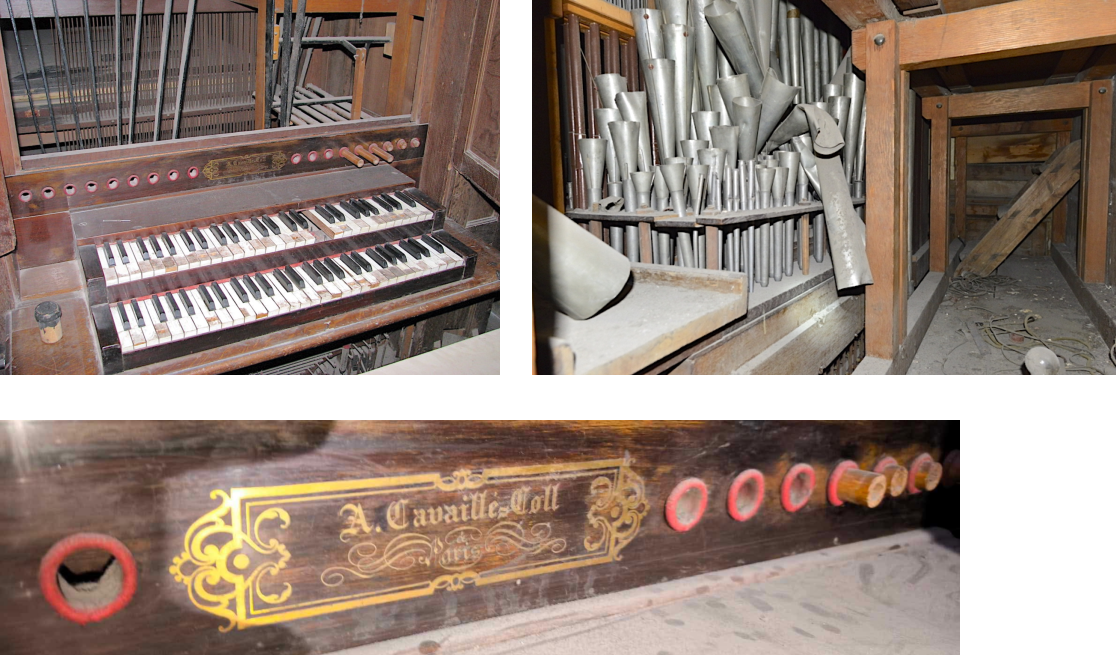
Since 1974, the organ has become unplayable and
undergoes visible malfeasance, especially on the
console. However, the original piping remains intact.
This organ is kept in its original location desired by its
manufacturer, which is unique in its genre.
Information supplied by Timothy Tikker (on facebook):
it was on 8" and 10" wind pressure, and I believe had no
pneumatic lever for the (mechanical) key action. The high
pressures were mainly because the organ was placed far
backstage -- cinema organs placed in chambers and
having as few ranks relative to the size of the hall used
these same pressures. The console was located with the
pipes, Cavaillé-Coll remarking that the organ was
designed for the pleasure of the audience, not of the
organist! The player could see the conductor via a series
of carefully-placed mirrors.
Attemps to save this organ are ongoing.
THE PARIS OPERA'S CAVAILLE-COLL ORGAN
Rollin Smith, The American organist


A recording
Although this organ is unplayable since 1974, a
handful of recordings keep the sound trail. The most
famous of these is the Faust recorded in 1953 under
the baton of André Cluytens (Emi): the organ
resonates at the beginning of Act IV (at 1:42:30) and
radiates in majesty for the final apotheosis ("Christ is
risen!")!
Organist: Henriette Puig-Roget
Source: Xavier Lebrun
(facebook)/www.diapasonmag.fr/histoire/le-vrai-
fantome-de-l-opera-32600


Silent








Organs of Paris


Opéra Garnier
Place de l'opéra, 75009 Paris
ORGANS OF PARIS © 2026 Vincent Hildebrandt

E6
Many are unaware that the Opera Garnier has an instrument
built by Cavaillé-Coll in 1874. The latter is totally invisible to
the general public since it is located on the court side at the
front stage with pipes at 12 meters in height.
The inauguration took place on January 8, 1875 with the
representation of the "Jewish" of Fromental Halévy. From that
moment on, the organ was used on a regular basis with
performances of works requiring its use.
However, the instrument suffered quickly from the dust
caused by the settings on the stage as well as very large
temperature differences.
A first warning call issued in 1893 by Cavaillé-Coll himself
who noticed that his instrument had never been dusted.
Subsequently, the condition of the organ deteriorated
further, some stops suffered from a loss of quality of their
timbre. Cavaillé considered the organ "in a state of disrepair"
in 1894.
In 1925, following a leak in the water supply of the fire
department, the organ was flooded and decommissioned.
Following this incident, Cavaillé-Coll / Convers was called to
carry out a restoration of the instrument with some
modifications, the most important being the installation of an
electric fan, installed in a separate room located under the
organ.
This instrument was last used on March 23, 1959 to celebrate
the centenary of the creation of "Faust" by Charles Gounod,
played by the André Marchal, who returned to play it
occasionally until 1964.
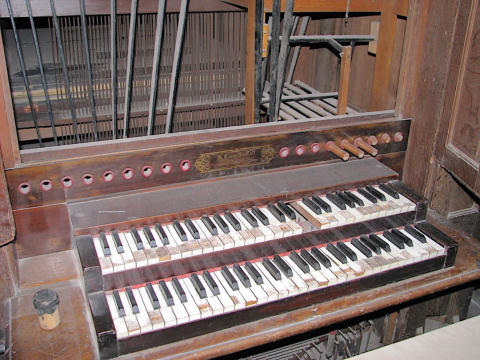
Since 1974, the organ has become unplayable and undergoes
visible malfeasance, especially on the console. However, the
original piping remains intact. This organ is kept in its original
location desired by its manufacturer, which is unique in its
genre.
Information supplied by Timothy Tikker (on facebook):
it was on 8" and 10" wind pressure, and I believe had no
pneumatic lever for the (mechanical) key action. The high
pressures were mainly because the organ was placed far
backstage -- cinema organs placed in chambers and having as
few ranks relative to the size of the hall used these same
pressures. The console was located with the pipes, Cavaillé-Coll
remarking that the organ was designed for the pleasure of the
audience, not of the organist! The player could see the conductor
via a series of carefully-placed mirrors.
Attemps to save this organ are ongoing.
THE PARIS OPERA'S CAVAILLE-COLL ORGAN
Rollin Smith, The American organist
A recording
Although this organ is unplayable since 1974, a handful of
recordings keep the sound trail. The most famous of these
is the Faust recorded in 1953 under the baton of André
Cluytens (Emi): the organ resonates at the beginning of Act
IV (at 1:42:30) and radiates in majesty for the final
apotheosis ("Christ is risen!")!
Organist: Henriette Puig-Roget
Source: Xavier Lebrun
(facebook)/www.diapasonmag.fr/histoire/le-vrai-fantome-de-l-
opera-32600
Silent
